Monday, May 27, 2013

Life of Pi by Yann Martel


          RICHARD PARKER!!! Sorry guys, my girlfriend saw this movie a few weeks ago and yelled “Richard Parker!” every time I mentioned that I was reading Life of Pi.

          This book was about a boy, sixteen year old Pi Patel, and his amazing adventure surviving on the ocean for 227 days. Not only is this book a tale of adventure and danger on the high seas, but it also has deeply introspective themes. These themes make the reader seriously inspect his or her own ideas about these themes. The two most prominent themes are Pi's feelings about animals and his feelings about religion. Pi is a vegetarian and the son of a zookeeper. He respects animals, enjoys them and cares for them. One of the most poignant thoughts that Pi expresses throughout the novel is that animals in zoos are not captives. Animals roam free in the wild because they need to gather food, water and remain safe. If animals are fed, watered, and safe, why wouldn't they be content to stay in one spot? Humans aren't captive because they live in houses, where they can obtain food, water, and safety. I found Pi's thoughts very convincing. I had never thought of zoos that way. Of course, the theory is only a theory, and only correct if the zoos take proper care of the animals. However, I could stand behind this theory until proven otherwise.

          The other theme of Pi's that I found even more poignant than the first is his views on religion. I won't go into too much detail here, but I found his thoughts incredibly open-minded and comforting. Pi is a boy who practices, not only his native Hindu, but also Christianity and Islam. He quotes Gandhi at one point, saying “All religions are true”. I found Pi's view on religion unique and uplifting in a way.

          Pi's take on life is also uplifting. Stranded on a lifeboat with a Bengal tiger named Richard Parker, still Pi strives to live and survive. He knows the odds are against him but he wants life nonetheless. Sometimes he succumbs to fear, which “kills,” as he puts it, but often he works to live. He abandons any practices that bar his survival, even his vegetarianism, eating whatever he could to stay alive. His attitude gives the book such an uplifting feel that the reader is actively invested in making sure that Pi stays alive too.

          The book is beautifully written. Some of the descriptions were confusing. However, this was because they were so detailed that it became hard to visualize the object without having seen a photo of it. The only other confusing points of the novel were to do with the formatting. There are certain chapters, marked by italics, that are the author's, Yann Martel's, opinions about Pi and his home while Pi is retelling his story. These chapters could be confusing until the reader catches on to what they are. The chapters were numerous and oddly cut apart. Some chapters were 20 pages while others were only one paragraph. The reader later learns that Pi wanted his story told in 100 chapters, but it was still confusing in trying to determine why a chapter stopped where it did.

          Overall, I absolutely loved this book. Not only full of adventure, the novel also gives the reader something to think about. This is the type of novel that can spur deep theological and social discussions in any setting. An amazing read, and one I would recommend wholeheartedly.

5/5 Stars


Friday, May 24, 2013

Intro and American Gods


          Hello, Everyone! Just thought I'd give a quick intro before I started in on my first review. I'm Holly...and well, this is my book review blog. I adore books and decided that I should put some of my hard-earned Lit major skills to some fun use and review books that I read. Feel free to email me or comment on books that you have read and tell me what you thought of them! I'd love to hear from any one who's reading my blog. I hope you enjoy!! Without further ado...

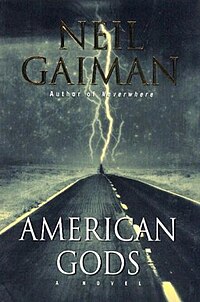
American Gods by Neil Gaiman


          The book is based around the idea of the “old gods” vs. the “new gods”. The old gods vary from Norse gods to primitive tribal gods from thousands of years ago to pretty much any ancient god you've ever heard of. The new gods are modern things: gods of technology, of television, of cars, etc. I really enjoyed the premise: the idea that the old gods followed their people when they came to America, then found themselves stuck in a world where they were disappearing from peoples minds replaced by modern technology. However, the book alludes to a battle between the two for over ¾ of the novel, only to disappoint in the end with a strange twist and no battle at all. While this may not bother some of you, I didn't enjoy spending an entire 500 pages waiting for what promised to be a very cool battle, only for a weak twist.

          As far as characters go, they varied. The main character, Shadow, was very...well...blank. About halfway through the book, his wife, Laura, even says of him “You're not dead...But I'm not sure if you're alive, either. Not really.” Shadow seems to have no deep thoughts of his own. The reader follows him throughout the book, but most of the time, is left to wonder why he is doing what he's doing. Why does he help Wednesday? What is his real motivation to do anything really? He is a static character, never changing--even after he meets gods, has a host of completely bizarre dreams, and takes trips to impossible places that shouldn't exist. Nothing seems to phase him. It is nice to know that Gaiman specifically intended for Shadow to seem so blank and dead. However, Shadow never struck me as a good main character. With such a blank character, the reader never gets a chance to feel any connection to what happens to Shadow. Deaths or crazy events have no effect on the reader since they seem to have no effect on Shadow. Even the death of his wife only brings emotion to Shadow for a few chapters at most.

          Many of the secondary characters were enjoyable and I had no issues with any of them. They were varied and well characterized, with, honestly, more motivation for their actions than Shadow. Czernobog and Mr. Nancy were particular favorites of mine. Both of them had unique personalities. The reader could clearly see why Czernobog did not want to join Wednesday's battle and why Mr. Nancy did. Hinzelmann was another favorite of mine. An old man prone to telling exaggerated stories, he provided the biggest twist to the end of the story. The twist in the plot surrounding Hinzelmann rescued the entire ending from mediocrity. Even Shadow's dead wife had better characterization than Shadow. At least her motivation for action was either rescuing Shadow, or maintaining as much of a life as a dead woman can achieve.

          All-in-all, I can say that, despite all my griping, it was a fairly enjoyable read. I have a fondness for Neil Gaiman's plots, even though his characters do tend to annoy me.


3/5 Stars